Last Updated: November 4, 2026
Quick Summary
To get faster roadside repair, call the number tied to your coverage first and give dispatch GPS coordinates, direction of travel, a mile marker, and the exact symptoms you see and hear. Clear, specific requests are triaged ahead of vague ones, so help is matched and sent sooner.
- Save your roadside assistance phone number in every truck and every driver’s phone.
- Report symptoms like grinding noise rather than guessing at the failed part.
- GPS coordinates beat every other location description and take ten seconds to pull up.
- Response time depends on location, time of day, weather and traffic, and service type.
- Run a mock breakdown call once a quarter to prepare drivers for after-hours repairs.
Table of Contents
- Why Some Roadside Calls Get Answered in 30 Minutes and Others Take Hours
- Step 1: Call the Right Roadside Assistance Phone Number First
- Step 2: Give Dispatch the Details That Cut Truck Roadside Repair Time
- Step 3: Pinpoint Your Location So the Tow Truck Finds You Fast
- Step 4: Understand What Drives Roadside Assistance Response Time
- Step 5: Verify and Improve Your Estimated Time of Arrival
- Step 6: Stay Safe on the Shoulder While You Wait for Help
- Step 7: How to Prepare Drivers for After-Hours Truck Repairs
- Frequently Asked Questions
Why Some Roadside Calls Get Answered in 30 Minutes and Others Take Hours
The difference between a fast roadside repair and a four-hour wait rarely comes down to luck. It comes down to what the driver says, who they call, and how precisely they describe where they are. This guide from Total360™ breaks down the seven moves that get a truck back on the road sooner, starting with the one most drivers get wrong.
Here is the core idea: dispatch sends help to the clearest request first. A driver who gives a mile marker, a direction of travel, and a callback number moves ahead of one who says “somewhere on I-80.” That is not favoritism. It is triage.
Below, we’ll show you exactly how to get faster roadside repair response, step by step, from the first phone call to the moment the technician arrives.
Step 1: Call the Right Roadside Assistance Phone Number First
Start with the channel tied to your coverage, not the first number that appears in a search.
Keep your roadside assistance phone number saved in every truck and in every driver’s phone. Print it on a card in the cab, too, because a dead phone battery should not stall the call.
Before you dial, know which line to use:
- Your plan’s dedicated claims or dispatch line
- Your fleet manager’s after-hours number
- A national emergency roadside service as a backup
Compare the channels before you need them
Response speed depends heavily on which channel you use. Each has trade-offs worth knowing in advance:
If you are unsure whether your policy covers the tow, check that before you commit to a provider. Our guide on whether commercial truck insurance covers emergency towing explains what typically counts and what does not.
Step 2: Give Dispatch the Details That Cut Truck Roadside Repair Time
Dispatch cannot send the right truck until they know what broke. Vague reports get a generic response. Specific reports get a matched one.
Have these ready before you call:
- Vehicle description: make, model, color, trailer type, and any placards
- Vehicle symptoms: “won’t start,” “air pressure loss,” “coolant leak,” “flat steer tire”
- Callback number: a phone that will actually ring
- Load details: weight, hazmat status, and whether the load is temperature-sensitive
The symptom matters most. A mobile repair unit that handles electrical faults is not the same truck sent for a tire change. Naming the problem correctly saves a second dispatch.
A common mistake is describing what you think is wrong instead of what you see and hear. Say “grinding noise from the rear axle at low speed,” not “I think the differential is shot.” The technician diagnoses. You report.
Step 3: Pinpoint Your Location So the Tow Truck Finds You Fast
Location is where most delays are born. GPS coordinates beat every other description, and they take ten seconds to pull up.
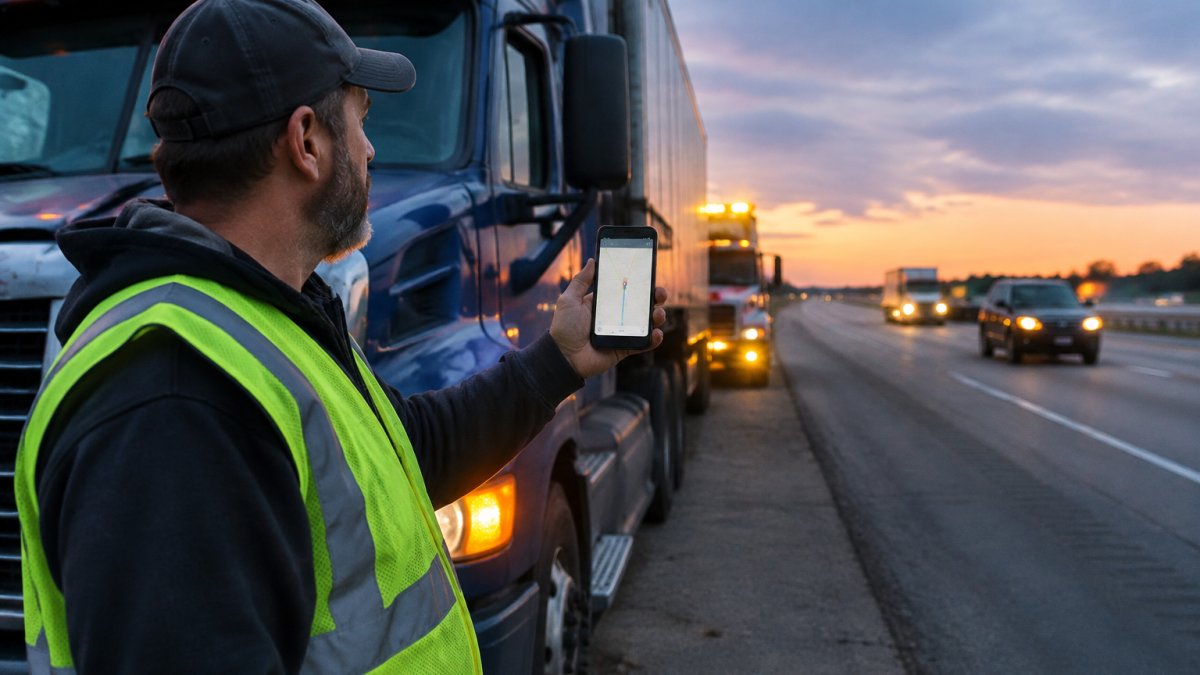
Give dispatch all of the following:
- GPS coordinates from your phone or ELD
- Highway number and direction of travel
- Nearest mile marker or exit
- A landmark the responder can see
A tool that shares your live location speeds this up further. The Total360™ mobile app helps dispatch locate your truck quickly and accurately, so the tow truck is not hunting the shoulder while you wait.
Step 4: Understand What Drives Roadside Assistance Response Time
Roadside assistance response time depends on four things: your location, the time of day, weather and traffic, and the type of service you need. A tire change on a rural interstate at noon is a different job than a heavy tow in a metro corridor at rush hour.
Here is how the main factors stack up:
| Factor | Speeds Up Response | Slows Down Response |
|---|---|---|
| Location | Clear mile marker, GPS shared | Vague description, no landmark |
| Time of day | Midday, off-peak | Rush hour, overnight |
| Weather | Clear and dry | Ice, fog, heavy rain |
| Service type | Tire, battery, fuel | Heavy tow, major repair |
Knowing this lets you set realistic expectations. A long wait is often a distance problem, not a service problem.
Step 5: Verify and Improve Your Estimated Time of Arrival
Ask for the estimated time of arrival and get it in writing, by text if possible. Then confirm it once the technician is dispatched, because the first number is often a rough guess.
When a claim is involved, knowing how the process works helps you move it along. Our claims process shows how repair coordination and reimbursement are handled, so you can plan the next breakdown better than this one.
Step 6: Stay Safe on the Shoulder While You Wait for Help
Safety comes before speed. A driver hurt on the shoulder turns a repair into an emergency. The right actions depend on where you are stopped and what the conditions are, so treat the checklist below as a baseline and adjust by situation.
Do these the moment you stop:
- Turn on hazard lights
- Set out reflective triangles behind the truck
- Put on a high-visibility vest
- Move behind the barrier if one exists
- Stay off the traffic side of the vehicle
Adjust for the situation
- Highway or interstate shoulder: The shoulder is the most dangerous place to wait. Stay in the cab with your seat belt on if there is no safe barrier, and exit only through the door away from traffic. Place triangles only when traffic allows and you can do it without stepping into a live lane.
- Poor visibility (fog, heavy rain, darkness): Increase following distance for responders by keeping hazards and marker lights on, and stay inside the vehicle unless there is a safer barrier. Reflective gear matters most here because a responder may see your vest before your truck.
- Severe weather (ice, snow, high wind): Keep the engine running for heat only if the exhaust is clear and you are not in an enclosed space. Watch for other vehicles losing traction near your position, and move behind a barrier if one is available.
- Unsafe location (curve, crest, tunnel, bridge, construction zone): If you can safely move the vehicle to a wider shoulder or exit, do so before calling. If you cannot move, tell dispatch exactly why the location is hazardous so the responder approaches with warning.
- No safe exit from the vehicle: If you cannot leave the cab safely, tell dispatch your situation and stay belted. Do not stand between the truck and traffic.
Visibility and road shoulder conditions change fast in bad weather. Our winter safety guide for truck drivers covers the cold-weather steps that keep a wait from turning dangerous.
Watch out: placing triangles or walking around the truck in low visibility or heavy traffic can put you in a live lane; if you cannot do it safely, stay in the vehicle and let the responder handle it.
Step 7: How to Prepare Drivers for After-Hours Truck Repairs
The best way to get faster roadside repair response at 2 a.m. is to prepare for it at noon. Drivers who know the drill before the breakdown happens move faster and make fewer mistakes.
Build a simple pre-trip routine:
- Save the dispatch number in every cab
- Keep a printed card with account and vehicle details
- Train drivers to pull GPS coordinates first
- Run a mock breakdown call once a quarter
Downtime is the real cost of a slow response. Our guide on ways to reduce commercial truck downtime covers the broader strategies that make every after-hours repair hurt less.
That is where a repair program earns its keep. Total360™ covers over 500 components, requires no inspections or mileage caps, and offers a 24/7/365 claims reimbursement option with a 60-minute customer response time. For fleets running older equipment, protection extends to vehicles up to 30 years old across Classes 2-8. For current pricing and plan details, visit Total360™ or request a quote. A reimbursement option and a defined response time can help fleets plan for the uncertainty of a breakdown, while Gales Recovery offers another perspective on what to expect when roadside assistance is needed.
Frequently Asked Questions
Why is my roadside assistance taking so long?
Most delays come from incomplete information or heavy demand. If dispatch has to call you back for a mile marker, direction of travel, or vehicle symptoms, the clock restarts. Weather, traffic conditions, and technician availability also stretch response time. Giving exact location details, a callback number, and a clear description of the breakdown on the first call is the fastest way to avoid a long wait.
What information should I give when requesting roadside repair?
Provide five things: your exact GPS location or mile marker with direction of travel, a full vehicle description including make, model, and plate, the symptoms you are seeing, a callback number, and whether you are loaded. Mention if the truck is blocking a lane or if cargo is hazardous. These details let the service provider match the right technician and equipment on the first dispatch, which shortens truck roadside repair time and reduces the chance of a second callout.
How long should I wait for roadside assistance before calling again?
Ask for an estimated time of arrival when you open the service request and note it. If the ETA passes with no automated alert, text message, or technician update, call back and ask for a status check. Most providers send GPS tracking links. Use that first, then call if the driver has not moved or the ETA keeps shifting. Waiting silently for hours rarely helps. A polite follow-up with your service request number gets a faster answer than starting a new request.
When should I request a tow instead of waiting for a roadside repair?
Request a tow when the vehicle cannot be made safe or drivable at the roadside: a blown steer tire with damage, a failed transmission, electrical faults that kill the engine, or anything involving a bent frame or leaking fuel. If the technician’s first assessment suggests a repair that needs a shop, ask for the tow immediately rather than waiting for a second visit. Coverage limits and towing reimbursement benefits affect your out-of-pocket cost, so confirm what your plan pays before the truck is hooked up.
Breakdowns will happen. The question is how fast your team responds and how little downtime it costs you. Total360™ gives fleets a repair program built for that reality, with broad component coverage, no inspection hurdles, and a claims line that answers around the clock.
Get started with Total360™ and keep your trucks moving with fewer surprises on the shoulder.