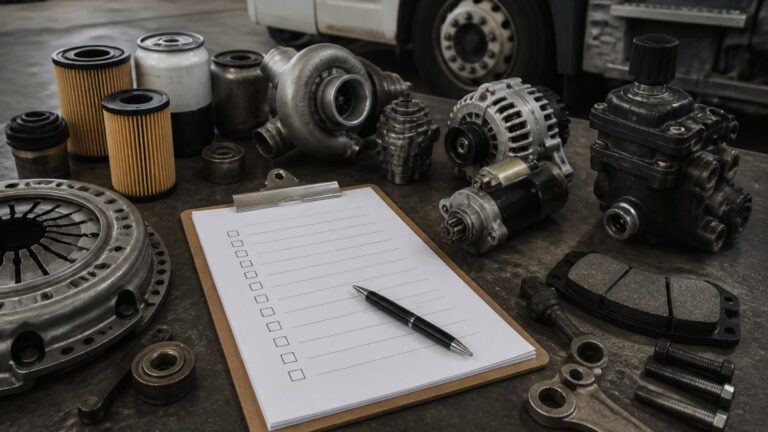
Quick Summary
A commercial vehicle component coverage checklist is a tool for sorting every major truck system into covered, excluded or conditional before you buy a warranty plan. Fleets use it to confirm who pays when a part fails, not just whether the part looks worn today.
- List every major system on your trucks and mark each as covered, excluded or conditional before signing.
- Ask the provider for the contract schedule in writing, since coverage is only real once it is named there.
- Keep the last twelve months of service logs ready, because conditional hubs and bearings depend on maintenance records.
- Get pre-authorization from the claims line before the shop starts teardown to avoid avoidable denials.
- Confirm vehicle class, age and use classification on the application so the quote matches how the truck operates.
Table of Contents
- Why a Component Coverage Checklist Matters for Your Fleet
- Engine and Powertrain Components to Verify
- Brake Systems, Tires, Wheels, and Hubs
- Fluids, Filters, Lights, and Electrical Systems
- Covered, Excluded, and Conditional Components Explained
- Commercial Truck Warranty Coverage by Vehicle Class and Age
- Comparing Plans Side by Side with a Coverage Worksheet
- Verifying Your Plan and Starting a Quote With Total360™
- Frequently Asked Questions
Last Updated: November 1, 2026
Fleet managers rarely lose sleep over the parts they can see on a pre-trip walkaround. The expensive surprises come from components buried in the powertrain, the air system and the electrical harness, the parts that fail quietly and then cost a week of downtime. A commercial vehicle component coverage checklist helps you sort those parts before a breakdown forces the question. Total360™ built its programs around this exact problem, covering over 500 components on Class 2-8 vehicles up to 30 years old.
Here is the core distinction to keep in mind. An inspection tells you what looks worn today. A coverage plan tells you who pays when a component fails tomorrow. Those are different questions, and many fleets only ask the first one.
Why a Component Coverage Checklist Matters for Your Fleet
We recommend treating the checklist as a purchasing tool, not a maintenance chore. Before you sign anything, list every major system on your trucks and mark whether each one is covered, excluded or conditional. Most disputes start because a buyer assumed a component was included.
Total360™ states that its plans cover over 500 components, and that the program has no mileage caps, inspections or qualifications required. Those are the claims to test against your own fleet. Ask the provider to confirm, in writing, which parts your specific trucks carry. Verifying these coverage details provides a necessary foundation for tracking the essential truck maintenance components that keep your operations running reliably.
Engine and Powertrain Components to Verify
The engine and transmission usually drive the largest repair bills, so start here. Check whether the plan covers the cylinder head, turbocharger, fuel injectors, water pump, transmission and differential by name. Ask about engine rebuilds directly, since many buyers find those excluded.

A common mistake is accepting “powertrain coverage” without reading the schedule. The schedule is where exclusions hide. Ask for a copy before you commit.
Brake Systems, Tires, Wheels, and Hubs
Brake components deserve their own line on the checklist. Confirm coverage for air compressors, brake chambers, slack adjusters and ABS modules. Pads and rotors are wear items in most programs, so verify whether they are covered at all.
Tires and wheels follow the same logic. Hubs and bearings are often conditional on maintenance records, so keep those records current. Our advice is to pull your last twelve months of service logs before you ask for a quote.
Fluids, Filters, Lights, and Electrical Systems
Fluids and filters are almost always maintenance items, not covered repairs. Mark them as excluded and budget for them separately. Lights, reflectors and the electrical harness are different: a failed alternator or wiring fault can be covered, while a burned-out bulb usually is not.
Watch out: a plan that covers the alternator may still exclude the wiring that connects it. Check both lines.
Covered, Excluded, and Conditional Components Explained
A usable checklist goes further: it sorts every major component into one of three columns and records the exact condition attached to each. That three-column sort separates inspection findings from warranty coverage decisions.
Column 1: Covered Components
Covered components are repaired or reimbursed when they fail from normal use during the contract term. On a commercial vehicle component coverage checklist, the covered column typically includes:
- Engine internals: cylinder heads, head gaskets, turbochargers, oil pumps, timing gears
- Fuel system: injectors, injection pumps, high-pressure fuel lines
- Cooling system: water pumps, radiators, thermostats, fan clutches
- Transmission and drivetrain: transmission internals, differentials, driveshafts, universal joints
- Air and electrical: air compressors, alternators, starters, ABS modules, ECM/PCM
- Chassis: leaf springs, spring hangers, steering gear boxes
Mark each one as covered only after you see it named in the contract schedule, not in a brochure.
Column 2: Excluded Components
Excluded components are never paid, regardless of failure mode. The most common exclusions on commercial truck warranty programs are:
- Wear items: brake pads, brake shoes, rotors, drums, clutch discs, wiper blades, belts and hoses
- Fluids and filters: engine oil, coolant, DEF, transmission fluid, oil and fuel filters
- Consumables: bulbs, fuses, tires, wheel seals
- Damage from outside causes: accidents, road hazards, vandalism, improper repairs, overheating from a failed cooling component
- Pre-existing conditions and failures present at the time of purchase
Mark these as excluded and budget for them in your maintenance line, not your coverage line.
Column 3: Conditional Components
Conditional components are the ones that generate most claim denials, because coverage depends on something the buyer controls. Common conditions include:
- Proof of scheduled maintenance: oil change records, service invoices, DOT annual inspection reports
- Authorized repair shops: some programs require pre-authorization before teardown
- Failure cause: a failed alternator may be covered, but the wiring harness it damaged may be excluded as consequential damage
- Vehicle age and mileage bands: coverage may narrow after a stated threshold
- Use classification: vehicles used for hauling, towing or off-road service may fall outside the plan
A component listed as “covered” in a sales conversation is not covered until the contract schedule names it and the conditions are satisfied. Ask for the schedule in writing before you sign.
Claim Documentation and Approval Workflow
A coverage checklist is only useful if you can actually collect on it. Build a claim file before you need one:
- Maintenance history, last 12 months of service invoices, oil analysis if available, and DOT annual inspection reports
- Diagnostics, fault codes, technician notes, and photos of the failed component before teardown
- Pre-authorization, call the claims line before the shop starts work; record the authorization number and the name of the representative
- Repair estimate, parts and labor broken out separately, with OEM or aftermarket part numbers
- Proof of payment, paid invoice and, if required, the replaced parts retained for inspection
A common pattern is a denial that could have been avoided because the shop tore down the engine before calling the claims line. Put the pre-authorization step at the top of your checklist, not the bottom.
The three-column sort, covered, excluded, conditional, is the checklist. If a component does not fit cleanly into one column, that is the question to ask the provider in writing.
Commercial Truck Warranty Coverage by Vehicle Class and Age
Coverage rarely looks the same across vehicle classes, and the top-ranking warranty explainers rarely break this down. The checklist below shows how component exposure shifts from light-duty to heavy-duty, so you can mark which columns apply to your fleet.
Coverage Differences by Vehicle Class
| Component group | Class 2-3 (light-duty) | Class 4-6 (medium-duty) | Class 7-8 (heavy-duty) |
|---|---|---|---|
| Engine internals | Often covered; smaller displacement, lower repair cost | Covered on most plans; turbo and injectors commonly named | Covered on most plans; cylinder head and turbo work drives the largest claims |
| Transmission | Automatic transmissions common; verify coverage of valve body and torque converter | Automatic and manual; verify clutch treatment as wear item | Manual and automated manual; clutch and release bearing usually excluded |
| Brakes | Hydraulic and air; ABS modules often covered, pads and rotors excluded | Air brakes common; compressors and chambers often covered | Air brakes standard; slack adjusters, chambers and compressors commonly named |
| Emissions aftertreatment | DEF system and DPF often conditional | DPF and SCR commonly conditional on maintenance records | DPF, SCR and DEF system frequently conditional; sensor failures often excluded |
| Electrical | Alternator, starter and ECM commonly covered | Same, plus body control modules | Same, plus telematics and APU wiring often excluded |
| Chassis and suspension | Leaf springs and steering commonly covered | Same, plus air suspension components | Air suspension, spring hangers and steering gear commonly named |
Use the table as a starting point, not a substitute for the contract schedule. A plan that covers a Class 8 tractor may treat a Class 3 box truck differently under the same brand.
How Age Bands Change the Schedule
Age is the second variable. A common pattern is a tiered schedule:
- Newer units (roughly 0-5 years): broadest component list, fewest conditions
- Mid-age units (roughly 6-10 years): coverage narrows on emissions and electrical; maintenance-record conditions tighten
- Older units (roughly 11+ years): coverage may be limited to major powertrain components, with higher deductibles or excluded systems
Total360™ lists coverage for Class 2-8 vehicles up to 30 years old, which is worth verifying against your oldest units. Ask the provider how the schedule changes at each age band and whether the deductible steps up as the vehicle ages.
Use Classification Matters as Much as Class
Two trucks in the same weight class can carry different coverage if their use differs. Vehicles used for hauling, towing, plowing or off-road service may fall outside standard plans or require a different tier. Confirm the use classification on the application matches how the truck actually operates.
Before you compare quotes, list every truck by class, age and primary use. A quote built on the wrong class or use classification is not a valid comparison.
Comparing Plans Side by Side with a Coverage Worksheet
Build a simple worksheet with one row per component and one column per plan. Fill each cell with covered, excluded or conditional, and note the condition. Add a column for downtime cost per day for your operation, since a cheap plan with slow claims can cost more than a pricier one.
Include a comparison of claim handling. Total360™ advertises a 60-minute customer response time and a 24/7/365 claims option. Test those claims by asking how the process works at 2 a.m. on a Sunday.
Verifying Your Plan and Starting a Quote With Total360™
Once your worksheet is complete, confirm the covered list against your actual fleet. Then request a quote from Total360™ to see how its component list applies to your trucks. Pricing depends on your fleet size, vehicle classes and ages, so request a quote tailored to your operation.
If you want to see the full scope of the program, review Total360™ coverage and its plan options before you start the quote. For a closer look at how tiers differ, our Tier 3 covered components page lists what the highest level protects. Fleets wondering about engine work specifically may also find whether fleet warranties cover engine rebuilds useful, and our commercial truck extended warranty cost guide breaks down how coverage shifts by vehicle class and age. Finally, the 500-component program overview shows the breadth of coverage before you fill out your worksheet.
GET A QUOTE!
Frequently Asked Questions
What components are typically covered by a commercial truck warranty?
Coverage varies by plan, so no universal list applies. Most plans address major mechanical systems such as the engine, transmission, drivetrain, and certain electrical and air system components. Total360™ states its program covers over 500 components for Class 2-8 vehicles. Read the contract’s component list and confirm each system you depend on is named, because a plan that sounds broad may still exclude a part your fleet fails on most often.
Are commercial truck warranties different from standard vehicle warranties?
Yes. Manufacturer warranties usually cover new vehicles for a set period or mileage, while commercial truck warranty programs are typically designed for older, higher-mileage trucks in service. Many plans are written around fleet use, with claim workflows and towing benefits suited to business operations. Compare eligibility rules, vehicle age limits, and whether the plan requires inspections before coverage begins.
What questions should I ask before buying a commercial truck warranty?
Ask which components are covered, which are excluded, and which are covered only under certain conditions. Confirm vehicle class and age eligibility, whether inspections or mileage caps apply, how claims are reimbursed, and whether towing is included. Ask how quickly claims are answered, and whether you can use your own mechanic. Request current pricing directly from the provider, since pricing depends on the plan, vehicle, and term.